SoulfulIn development 2026
Redesigning daily affirmations
- Role
- Product Owner and Designer
- Skills
- Figma, Xcode, Framer, Supabase, Claude Code
Challenge
Reinventing an established category
With Soulful I set out to build an affirmations app that doesn’t treat the content as something to be passively consumed, but something to be practiced intentionally. This required rethinking the category from the ground up.
My high level goals were to:
- Identify the specific feature gap through competitive analysis
- Design a feedback loop that converts intention-setting into action
Problem
The category is stuck in the wrong loop
I tested 5 popular affirmation apps over a week. The overall experience was remarkably similar across all of them: select a category, swipe through affirmations, favorite them, and loop back. The experience began and ended with infinite scroll.
Without a bridge from intention to action, the apps become digital quote collections.
Design question
How can practice prompts tied to specific affirmations strengthen the user experience?
A 2006 meta-analysis across 94 studies on implementation intentions — Gollwitzer's work on if-then plans — found moderate-to-large effects on goal achievement when people specified when and where they'd act on an intention, not just what they wanted to change.
Exploration
The missing link
Bridging this gap meant building a path from reading to doing. I experimented with several approaches, including a multi-step "flow" model that walked users through a series of micro-practices in sequence, before letting them pick one to complete later.
This model still relied on an infinite-scroll feed of affirmations.
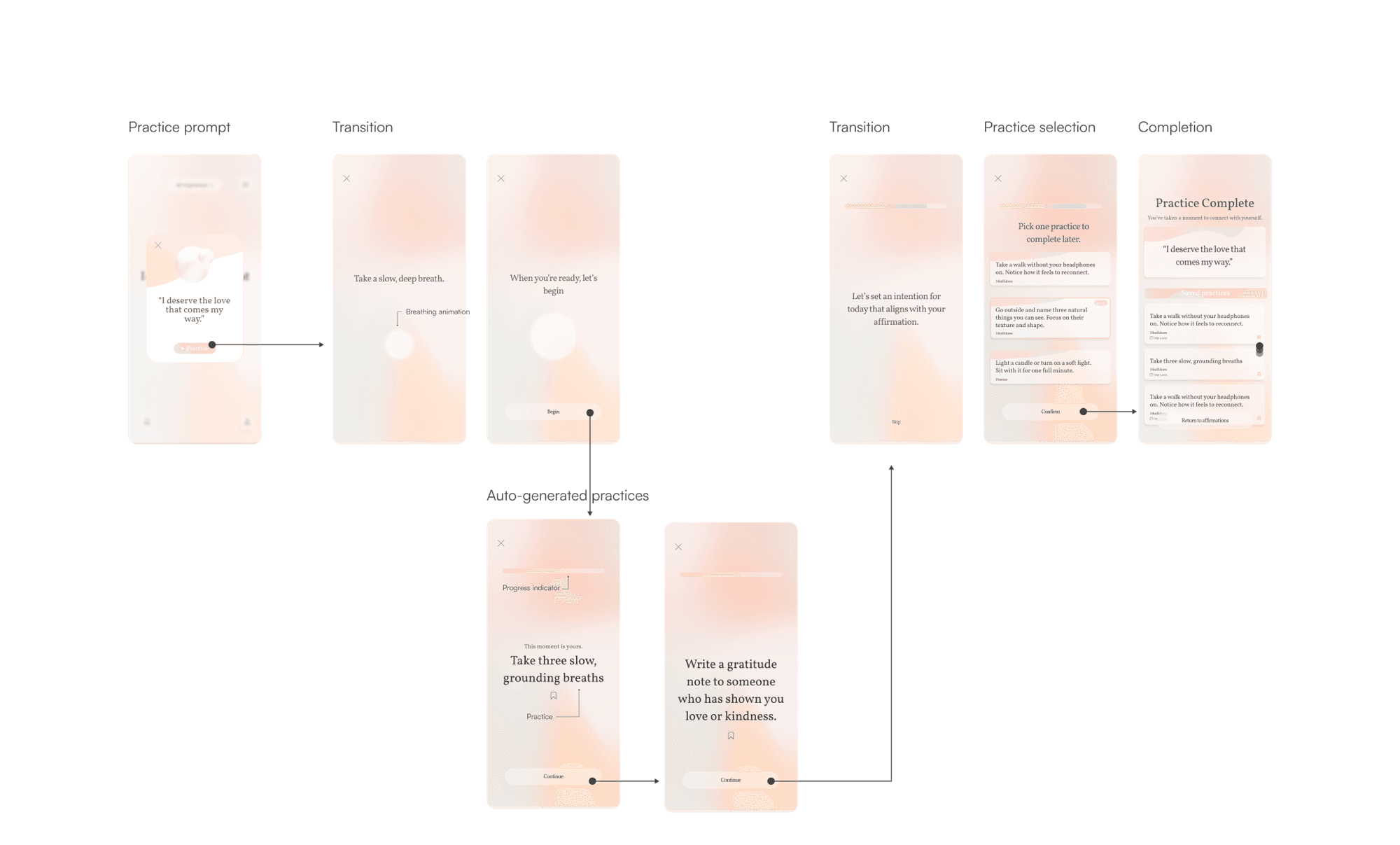
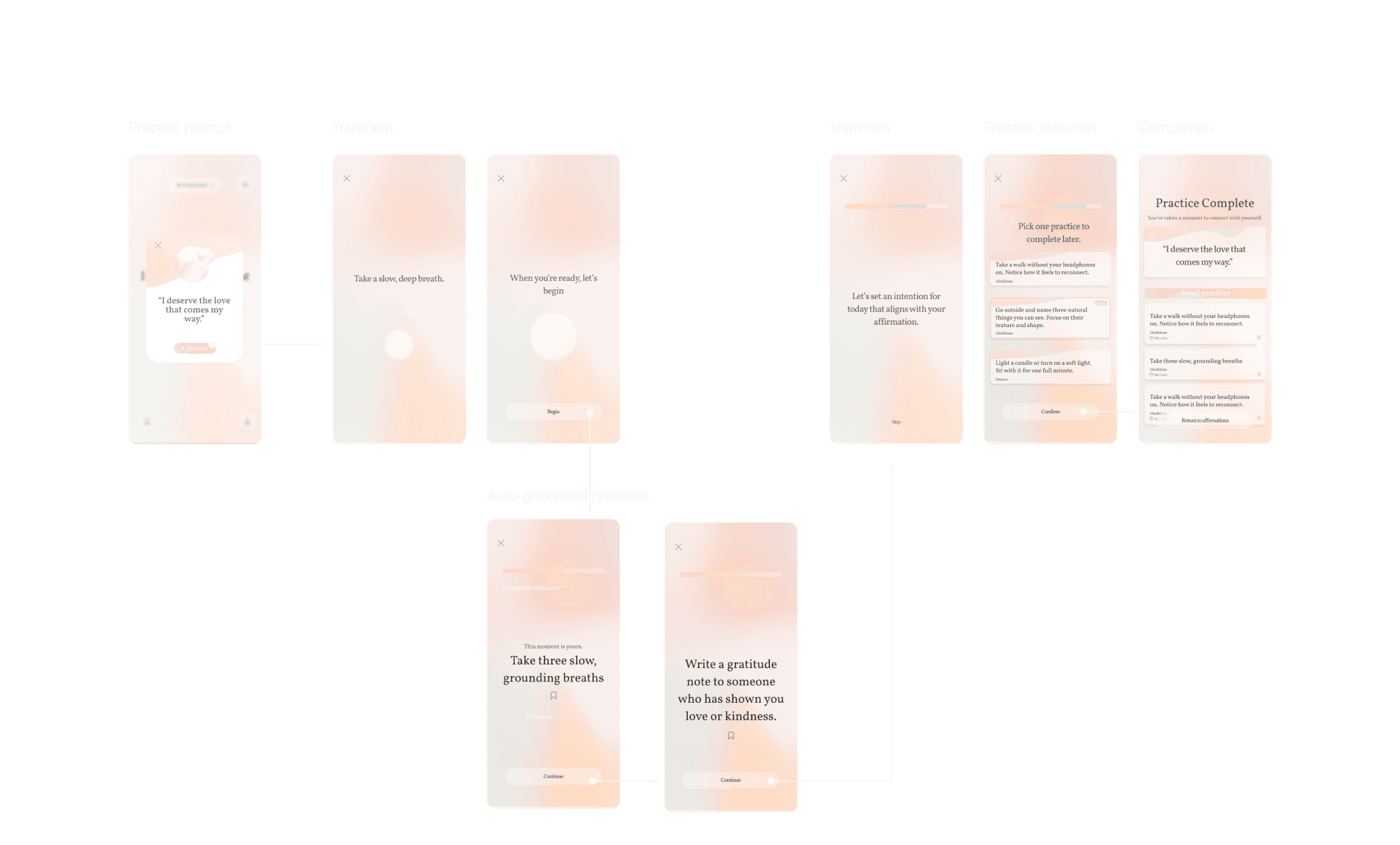
In early prototype testing, users found the flow model too cumbersome. The sequential format also created a design constraint: most practices had to be completable in the moment, which limited the range of practices that could be included.
Solution
One goal, one affirmation
The unlock came when I stripped away the infinite feed in favor of a more structured approach.
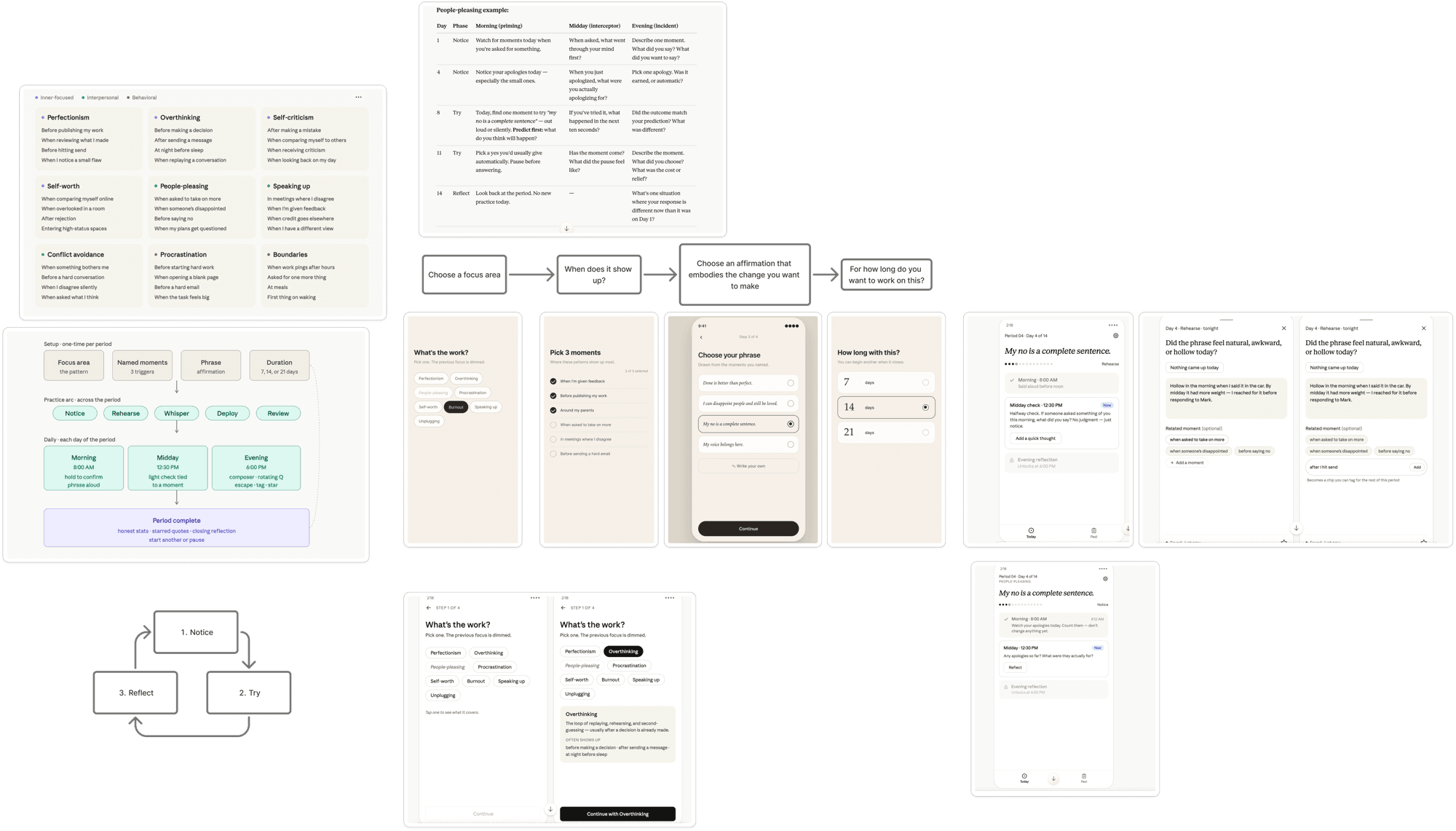
This new model allowed the user to pick an area of work (e.g. perfectionism, over-thinking) and tie it to one specific affirmation of their choice.
The chosen affirmation would be practiced daily for a set amount of time (e.g. 2 weeks) through specific actionable prompts.
Onboarding
Daily user flow
Reflection
What I learned
A bounded period changes the contract
Open-ended affirmation feeds let the user off the hook by never asking them to finish. Committing to one phrase for a fixed length — and ending with a real reflection — was what made the practice land.